AUSTIN US
AUSTIN
HomeLaboratoryEnsayo triaxial

Triaxial Testing for Austin Foundations

Rigorous testing. Clear reporting.

LEARN MORE

A six-story apartment complex near Lady Bird Lake needed foundation design data. The contractor wanted to maximize the basement depth without overspending on shoring. We ran a series of triaxial tests on undisturbed samples extracted from three boreholes. The project required consolidated undrained (CU) tests under effective stress conditions. Results showed an effective friction angle of 31 degrees with cohesion near 2 kPa. That data drove the final mat foundation design. Without these triaxial results, the geotechnical engineer would have overestimated bearing capacity by nearly 25 percent. We also cross-checked our findings with a resistivity survey to map variability across the site. The combination of methods saved the client thousands in unnecessary excavation.
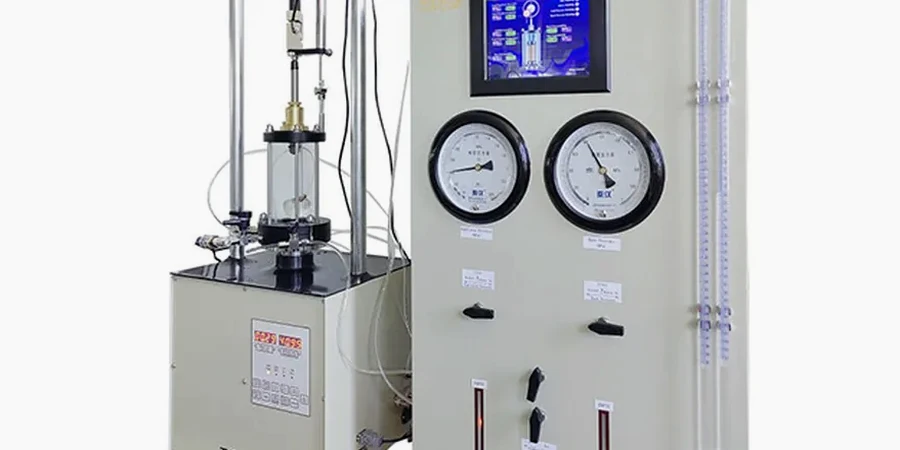
Illustrative image of Triaxial test in Austin
A single triaxial test failure envelope can shift a mat foundation thickness by 15 percent. Site-specific data eliminates that guesswork.
Our service areas

This service complements our laboratory testing work for a complete project analysis.

Process overview

Silty clays east of I-35 behave very differently from the sandy gravels found near the Colorado River. In South Austin, high plasticity clays dominate the upper 8 meters. North Austin often presents interbedded claystone layers with higher stiffness. These contrasting profiles demand site-specific triaxial testing. A single correlation from a nearby project is not reliable here. Our lab runs both UU and CU triaxial procedures depending on the loading scenario. For rapid construction, we use ASTM D2850 on undisturbed tube samples. Long-term stability analysis requires CU tests with pore pressure measurement per ASTM D4767. We combine these results with Atterberg limits to classify plasticity and predict volume change potential. This layered approach gives the design team full confidence in the strength envelope.
Technical reference — Austin

Local context

Austin grew rapidly over the past two decades. Many subdivisions were built on what used to be ranchland with shallow clay crusts over weathered limestone. The risk shows up when heavy loads are placed without proper strength characterization. Insufficient triaxial data can lead to punching shear failures in stiff clays. We have seen cases where assumed friction angles were 6 degrees too high. That discrepancy caused differential settlements exceeding 40 mm within the first year. A thorough triaxial program on representative samples mitigates that risk entirely. Our team tailors the confining pressures to match the actual overburden conditions at each site.

Need a geotechnical assessment?

Reply within 24h.

Email: contact@geotechnicalengineering1.com

Visual overview


Relevant standards

ASTM D2850-15, ASTM D4767-11, ASTM D7181-11

Technical data


ParameterTypical value
Effective cohesion (c')0 - 15 kPa
Effective friction angle (phi')28 - 38 degrees
Undrained shear strength (Su)30 - 180 kPa
Pore pressure parameter B0.90 - 0.98
Strain rate (CU test)0.05 - 0.10 mm/min
Confining pressure range50 - 600 kPa

FAQ

What is the difference between CU and UU triaxial tests?

CU tests consolidate the sample under confining pressure then shear it without drainage, measuring pore pressure. UU tests skip consolidation and shear immediately. CU gives effective stress parameters for long-term analysis; UU gives total stress parameters for short-term conditions.

How many samples do I need for a representative triaxial program in Austin?

A minimum of three samples per soil layer is standard. For variable sites like those along the Balcones Fault Zone, five samples per layer provide more reliable statistics. Each sample is tested at a different confining pressure to define the Mohr-Coulomb failure envelope.

How much does a triaxial test cost in Austin?

The typical range for a CU triaxial test including setup, saturation, consolidation, and shearing is between US$1,850 and US$2,470 per sample. Volume discounts apply when testing multiple samples from the same project.

Does the high plasticity clay in Austin affect triaxial test results?

Yes, high plasticity clays require longer saturation and consolidation times. We use back-pressure saturation to achieve a B parameter above 0.95 before shearing. Slow strain rates prevent pore pressure equilibration issues common in Austin's expansive soils.

Location and service area

We serve projects across Austin.

Location and service area