AUSTIN US
AUSTIN
HomeIn-SituEnsayo Dilatómetro (DMT)

Flat Dilatometer Test (DMT) in Austin | In-Situ Geotechnical Testing

Rigorous testing. Clear reporting.

LEARN MORE

Austin sits on the Balcones Fault Zone, a tectonic hinge that juxtaposes the Edwards Plateau limestone against the deep alluvial clays and sands of the Blackland Prairie. This geological transition means a site just a few blocks apart can show radically different soil behavior. The Flat Dilatometer Test (DMT) is our preferred tool for capturing that variation in situ, giving us the lateral stress coefficient (K0), the horizontal modulus of deformation (ED), and the material index (ID) in real time. Unlike laboratory tests that require undisturbed sampling and transport — which can alter the stress state of Austin’s highly plastic clays — the DMT measures directly in the ground, preserving the true fabric of the deposit. We run it in conjunction with a georradar-gpr survey when we need to correlate stratigraphic boundaries across a large site, and we always cross-check DMT readings against sondaje-spt blow counts for a complete picture of strength and stiffness.
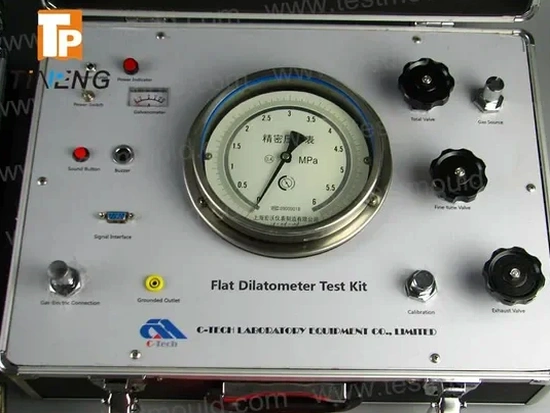
Illustrative image of Flat Dilatometer Test (DMT) in Austin
In Austin’s expansive clays, DMT-derived K0 values of 0.8–1.2 are common — 50 % higher than typical preliminary assumptions that drive overdesign.

Our service areas

Process overview

A common mistake we see from contractors in Austin is assuming that the upper Taylor Clay has the same stiffness profile as the deeper Navarro formation. That assumption usually leads to overly conservative — or worse, unsafe — foundation designs. The DMT delivers six key parameters from a single push: material index, horizontal stress index, dilatometer modulus, undrained shear strength (Su), constrained modulus (M), and the coefficient of lateral earth pressure at rest (K0). We follow ASTM D6635-15 strictly, using a 15 cm² blade advanced at 20 mm/s with readings taken every 200 mm. The test is quick — a 20 m profile takes about 45 minutes — and the results are interpreted on-site. We have found that for Austin’s stiff clays, the DMT-derived K0 values are typically 0.8–1.2, which is markedly higher than the 0.5 often assumed in preliminary designs. That difference alone can save a project 15–20 % on foundation concrete volume.
Technical reference — Austin

Local context

In Austin, many times we see that the DMT interpretation is done with default soil models calibrated on Italian or Japanese clays, which differ significantly from the local expansive clays. The high-plasticity Taylor Clay (CH) has a liquid limit often above 70 % and a plasticity index around 45–50. If you use a generic correlation for Su from KD, you can overestimate strength by 30 % or more. We calibrate our DMT reductions with site-specific index properties and occasionally run a limites-atterberg on the same borehole material to adjust the interpretation. Ignoring this calibration step leads to differential settlement in lightly loaded structures like residential slabs and tilt-up panels, which are common in Austin’s suburban developments.

Need a geotechnical assessment?

Reply within 24h.

Email: contact@geotechnicalengineering1.com

Visual overview


Relevant standards

ASTM D6635-15: Standard Test Method for Performing the Flat Plate Dilatometer, ASTM D2487-17: Standard Practice for Classification of Soils for Engineering Purposes, IBC 2021: Chapter 18 – Soils and Foundations (site classification requirements)

Technical data


ParameterTypical value
Material Index (ID)0.1–10 (clay to sand classification)
Horizontal Stress Index (KD)1.5–6.0 (overconsolidation indicator)
Dilatometer Modulus (ED)5–80 MPa (stiffness parameter)
Undrained Shear Strength (Su)50–400 kPa (for cohesive soils)
Constrained Modulus (M)5–200 MPa (settlement analysis)
Coefficient of Lateral Earth Pressure (K0)0.5–2.0 (in-situ stress state)

FAQ

What is the difference between DMT and CPT for Austin soils?

Both are in-situ penetration tests, but DMT is preferred in stiff overconsolidated clays like Austin's Taylor Clay because the blade's flat face measures horizontal stress directly without the cone's tip correction. DMT gives a direct K0 value, while CPT requires empirical correlations that often underestimate K0 in high-plasticity soils. We use CPT for profiling in sandy alluvium and DMT for clay-dominated profiles.

How much does a Flat Dilatometer Test cost in Austin?

A standard DMT sounding to 20 m depth typically ranges between US$720 and US$990 per borehole, including mobilization within the Austin metro area, field testing, data reduction, and a preliminary report. The final cost depends on the number of soundings, access conditions, and whether dissipation or seismic modules are added. We provide a fixed quote after a brief site review.

Can DMT be used to design drilled shafts in Austin's limestone?

The DMT blade cannot penetrate competent limestone — it is designed for soils and soft rock. In Austin, we use DMT in the overlying clay strata to assess the lateral resistance and downdrag on drilled shafts, while the rock socket design relies on rock coring and compressive strength testing. The DMT data helps optimize the shaft length by quantifying the clay's stiffness and K0 for lateral load analysis.

How does DMT help with expansive soil problems in Austin?

Expansive clays in Austin (Taylor, Navarro, and Ozan formations) undergo volume change with moisture variation. The DMT provides the horizontal stress index (KD), which correlates directly with the overconsolidation ratio (OCR) and the swelling potential. Soils with KD > 4.0 indicate high OCR and high swell pressure. We use DMT profiles to map the depth and extent of critical swell zones, then recommend moisture barriers, deep foundations, or soil replacement accordingly.

Location and service area

We serve projects across Austin.

Location and service area