AUSTIN US
AUSTIN
HomeSlopes & WallsRetaining Wall Design for Austin's Challenging Soils

Retaining Wall Design for Austin's Challenging Soils

Rigorous testing. Clear reporting.

LEARN MORE

Designing a retaining wall in Austin is a different challenge near Lady Bird Lake compared to the limestone ridges of the Hill Country. In the downtown area, you often encounter deep layers of expansive clay that swell with moisture, while western neighborhoods like Westlake sit on shallow bedrock with thin soils. A wall that works on the west side can buckle or slide in the floodplain clays of East Austin. That is why we always start with a site-specific geotechnical investigation before proposing a wall type. Understanding the soil profile determines whether a cantilevered reinforced concrete wall or a mechanically stabilized earth system is appropriate. We frequently combine this analysis with a permeability field test to assess drainage conditions and a resistivity survey to locate buried utilities before excavation begins.
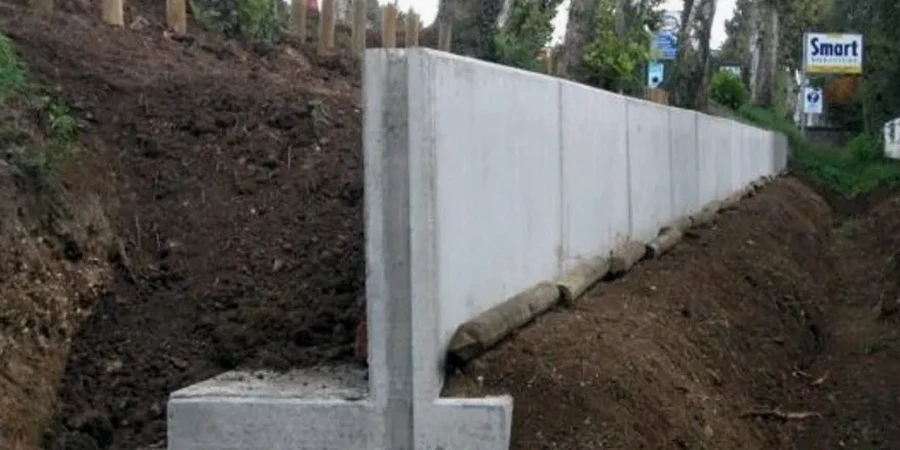
Illustrative image of Retaining wall design in Austin
Expansive clays in Austin can exert lateral pressures exceeding 100 psf equivalent fluid weight when fully saturated, requiring careful drainage design.

Our service areas

This service complements our laboratory testing work for a complete project analysis.

Process overview

Retaining wall design in Austin must follow the IBC 2021 and ASCE 7-16, with special attention to the expansive soil provisions in Chapter 18 of the IBC. The city's clay soils can exert lateral pressures exceeding 100 psf equivalent fluid weight when saturated, so we calculate active and passive earth pressures using the Coulomb method modified for unsaturated conditions. Our laboratory runs Atterberg limits (ASTM D4318) and free swell tests on every sample to classify the shrink-swell potential. When the plasticity index exceeds 30, we recommend a drainage blanket and waterproofing membrane behind the wall. For taller walls, we integrate a deep soil mixing treatment beneath the footing to control differential settlement. The geotechnical report includes a sliding and overturning check, bearing capacity verification, and global stability analysis using Bishop's simplified method. All calculations are stamped by a licensed professional engineer registered in Texas.
Technical reference — Austin

Local context

The biggest risk for retaining walls in Austin is hydrostatic pressure buildup behind the wall after heavy rain. The city averages 34 inches of rainfall per year, with intense afternoon thunderstorms that can saturate clay in hours. We install a 6-inch perforated drain pipe wrapped in geotextile fabric at the base of every wall, connected to a daylight outlet or sump pump. Without this, the wall can face twice the design pressure and fail suddenly. Another hazard is the presence of dissolving limestone cavities beneath the footing. We routinely perform a GPR survey to detect voids before concrete placement. If a cavity is found, we fill it with lean concrete or structural fill under the footing to prevent a punch-through failure.

Need a geotechnical assessment?

Reply within 24h.

Email: contact@geotechnicalengineering1.com

Relevant standards


IBC 2021 (International Building Code), ASCE 7-16 (Minimum Design Loads for Buildings), ASTM D4318 (Atterberg Limits), AASHTO LRFD Bridge Design Specifications (Section 11 - Retaining Walls)

Technical data

ParameterTypical value
Wall Height Range3 ft to 25 ft
Design Life50 years (typical)
Active Earth Pressure Coefficient (Ka)0.30 - 0.45 depending on soil type
Surcharge Load250 psf minimum (IBC Table 1607.1)
Seismic Coefficient (SDS)0.20g - 0.35g (Austin zone)
Factor of Safety - Sliding1.5 (ASD) / 1.0 (LRFD)

FAQ


What is the typical cost range for retaining wall design in Austin?

The cost for geotechnical analysis and design of a retaining wall in Austin ranges between US$930 and US$4.180, depending on wall height, number of borings, and laboratory testing. This includes the site investigation, soil classification, and sealed engineering report.

How deep do soil borings need to be for a retaining wall?

Borings should extend at least 5 feet below the bottom of the wall footing or to a depth equal to 1.5 times the wall height, whichever is deeper. In Austin's clay soils, we often drill to 20 feet to capture the full expansive zone.

Do I need a permit for a retaining wall in Austin?

Yes. The City of Austin requires a building permit for any retaining wall over 4 feet in height. The permit application must include a geotechnical report and structural calculations sealed by a Texas-licensed engineer.

What drainage system is recommended for Austin's clay soils?

A 6-inch perforated PVC pipe wrapped in non-woven geotextile, placed at the base of the wall and connected to a positive outlet. We also specify a 12-inch-wide gravel drainage blanket behind the wall to relieve hydrostatic pressure.

Location and service area

We serve projects across Austin.

Location and service area