Austin's explosive growth from a quiet college town into a tech hub has reshaped its skyline, but the underlying geology remains a challenge. The city sits atop the Balcones Fault Zone, a transition between Cretaceous limestone and deep clay-rich alluvial deposits along the Colorado River. For high-rise projects downtown or heavy industrial slabs along the I-35 corridor, the Ménard pressuremeter test (PMT) is the go-to in-situ method for determining deformation modulus (E_M) and limit pressure (p_L). This test directly measures soil stiffness under controlled radial expansion, giving us numbers we can trust for settlement analysis. We run the PMT following ASTM D4719-20, using a 60 mm probe inflated in pre-drilled boreholes; the data feeds directly into the design of drilled shafts and mat foundations. Before deploying the pressuremeter, we often correlate results with a resistivity survey (SEV) to map lateral variability across the site.
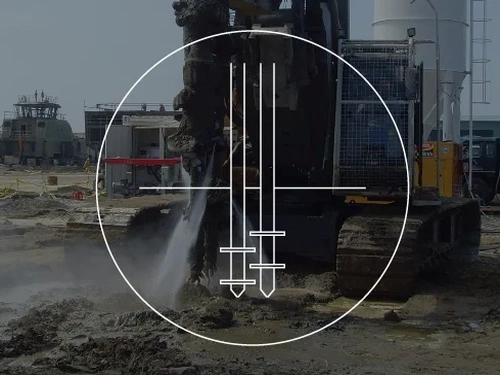
The Ménard pressuremeter delivers the only direct measure of in-situ deformation modulus — no empirical correlations, no correction factors — just the real stiffness of the ground at the design depth.