AUSTIN US
AUSTIN
HomeGeophysicsGeorradar GPR (Ground Penetrating Radar)

GPR (Ground Penetrating Radar) Survey in Austin

Rigorous testing. Clear reporting.

LEARN MORE

In Austin, the combination of limestone bedrock, clay-rich soils, and extensive utility corridors makes subsurface investigation both critical and challenging. A GPR (Ground Penetrating Radar) survey offers a non-invasive way to map buried objects, voids, and stratigraphy before breaking ground. This method aligns with IBC Chapter 18 requirements for site characterization and is often the first step in a broader geotechnical program. When integrated with calicatas exploratorias for direct soil verification, GPR data becomes even more reliable for identifying karst features common in the Edwards Aquifer recharge zone. The technology uses high-frequency electromagnetic pulses to produce real-time cross-sections of the ground, allowing teams to see what lies beneath without disturbing the surface.
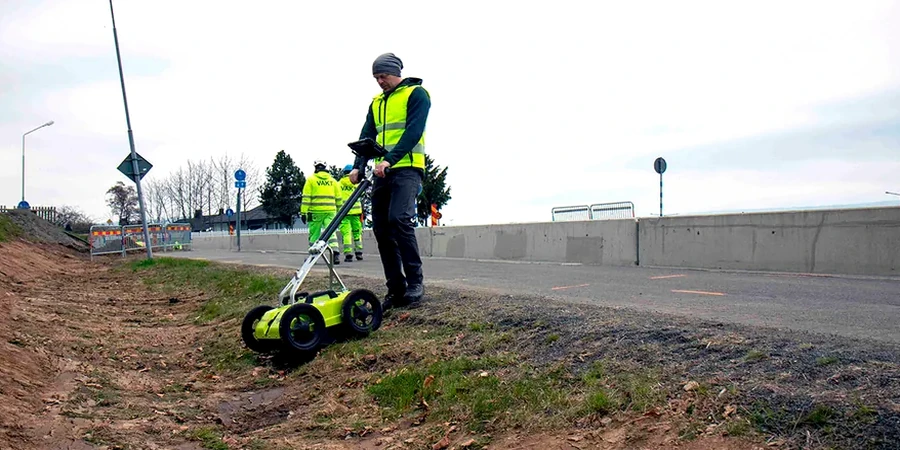
Illustrative image of GPR (Ground Penetrating Radar) survey in Austin
A well-executed GPR survey in Austin can reduce unexpected excavation costs by up to 30% by revealing buried utilities and karst voids before the first shovel hits the ground.

Our service areas

This service complements our laboratory testing work for a complete project analysis.

Process overview

A typical GPR survey in Austin starts with a walkover of the site using a 400 MHz or 900 MHz antenna, depending on target depth. For utility location, the 400 MHz antenna reaches 3 to 5 meters, while higher frequencies provide better resolution for shallow features like rebar or conduits. The equipment records reflections from changes in dielectric permittivity — a contrast that reveals pipes, cables, and even soil layer boundaries. Data is processed on-site and later interpreted using RADAN software. For projects requiring deeper structural information, results pair naturally with a ensayo CPT to correlate radar anomalies with cone penetration resistance. The survey delivers:
  • Real-time imaging of buried utilities and unknown obstructions
  • Detection of voids and solution cavities in limestone bedrock
  • Mapping of soil stratigraphy and bedrock depth
  • Identification of rebar patterns in existing concrete slabs
Technical reference — Austin

Local context

In Austin, many construction teams discover that the biggest risk isn't the soil itself — it's what lies hidden within it. Old utility lines from the 1960s, undocumented septic tanks, and solution cavities in the Glen Rose limestone are common surprises. A GPR survey before excavation helps avoid costly shutdowns and safety hazards. The city's growing density means that even small residential lots may have abandoned water lines or buried debris from previous demolition. Without this scan, contractors often hit something unexpected within the first two feet of digging.

Need a geotechnical assessment?

Reply within 24h.

Email: contact@geotechnicalengineering1.com

Visual overview


Relevant standards

ASTM D6432-19 Standard Guide for Using the Surface Ground Penetrating Radar Method, IBC 2021 Chapter 18 — Site Characterization and Foundation Investigation, FHWA-RD-03-053 — Ground Penetrating Radar for Highway Applications

Technical data


ParameterTypical value
Antenna frequency400 MHz (standard), 900 MHz (shallow), 200 MHz (deep)
Maximum depth penetration5 m in dry sand/limestone; 2 m in clay-rich soil
Resolution5 cm at 900 MHz; 15 cm at 400 MHz
Data formatRADAN .DZT, SEG-Y, or proprietary grid files
Survey speed1–3 km/h depending on terrain and grid spacing
Post-processingTime-zero correction, gain adjustment, migration filter

FAQ

How deep can GPR penetrate in typical Austin soils?

In Austin, depth depends on soil composition and moisture. Dry sand or limestone allows up to 5 meters. Clay-rich soils, common in the Blackland Prairie, reduce penetration to 1–2 meters. We optimize antenna frequency based on site conditions.

What is the typical cost of a GPR survey in Austin?

For a standard residential lot or commercial pad, the cost ranges from US$8,920 to US$1,290 depending on area size, grid density, and target depth. A full city block or linear utility corridor sits at the higher end. Contact us for a site-specific quote.

Can GPR detect voids under existing concrete slabs?

Yes, GPR is highly effective at detecting voids, delamination, and poor compaction under slabs. The 900 MHz antenna provides the resolution needed to see gaps as thin as 2 cm. We routinely use this for parking garages and warehouse floors in Austin.

Is a permit required for GPR surveys in Austin?

No permit is needed for private property surveys. For public right-of-way work (sidewalks, streets), Austin requires a Traffic Control Plan and a Right-of-Way Permit from the Transportation Department. We handle all coordination.

Location and service area

We serve projects across Austin.

Location and service area