AUSTIN US
AUSTIN
HomeImprovementDeep Soil Mixing Design

Deep Soil Mixing Design in Austin – Geotechnical Solutions for Expansive Clays

Rigorous testing. Clear reporting.

LEARN MORE

Austin's rapid growth since the 1980s transformed a quiet college town into a tech hub, but the city's geology remains a challenge. The area sits atop the Balcones Fault Zone, with deep layers of expansive clay (Taylor Marl, Ozan Formation) interbedded with sand and gravel lenses. For any structure founded on these soils, deep soil mixing design in Austin must account for high plasticity indices and fluctuating moisture levels. The method works by mechanically blending cementitious binders with in-situ soil to create columns or panels of improved strength and reduced permeability. This technique is particularly effective where conventional deep foundations face difficulties due to variable bearing strata or where excavation support is needed without dewatering. Before specifying the mix design, the team reviews local borehole logs and runs laboratory tests to determine the natural moisture content, organic content, and sulfate concentration — all factors that influence binder selection and target unconfined compressive strength.
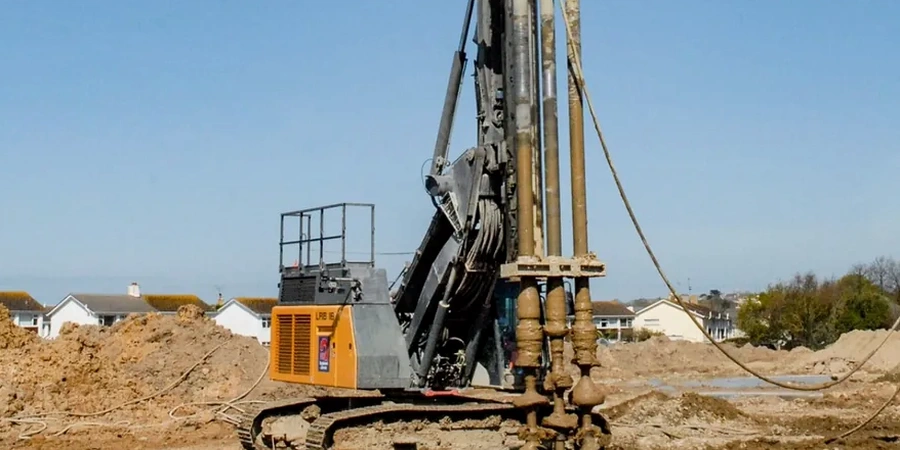
Illustrative image of Deep Soil Mixing (DSM) design in Austin
Each Austin site demands its own mix design — the Taylor Marl reacts differently than Colorado River terrace deposits, and assuming otherwise leads to underperformance.

Our service areas

Process overview

A common mistake among contractors in Austin is assuming that a single binder ratio works across all soil types found on the same site. The Taylor Marl, for example, contains smectite clays that react differently to cement than the silty sands of the Colorado River terrace deposits. A proper deep soil mixing design in Austin requires site-specific mix design trials using actual soil samples. These trials determine the optimum binder type (ordinary Portland cement, slag cement, or a blend), the water-to-binder ratio, and the required curing time to achieve the design strength. The process follows ASTM D1586 for soil classification and ASTM D1633 for unconfined compressive strength testing of soil-cement specimens. For projects where groundwater control is critical, the design also incorporates permeability testing to verify that the treated columns achieve the target hydraulic conductivity. The final design report includes a column layout plan, strength contours, and quality control criteria for field verification during production.
Technical reference — Austin

Local context

In Austin, many times we see that engineers specify deep soil mixing without considering the high sulfate concentrations present in certain areas of the city, particularly near the Onion Creek and Walnut Creek watersheds. Sulfates react with cement to form ettringite, which causes swelling and loss of strength over time. A deep soil mixing design in Austin that ignores this chemical risk can result in column heave and loss of support within months. The solution is to perform a sulfate soundness test (ASTM C1012) on the in-situ soil before finalizing the binder formulation. When sulfate levels exceed 3,000 ppm, the design must switch to sulfate-resistant cement or add ground granulated blast furnace slag to mitigate the reaction.

Need a geotechnical assessment?

Reply within 24h.

Email: contact@geotechnicalengineering1.com

Visual overview


Relevant standards

ASTM D1633 – Standard Test Method for Compressive Strength of Molded Soil-Cement Cylinders, ASTM C1012 – Standard Test Method for Length Change of Hydraulic-Cement Mortars Exposed to a Sulfate Solution, FHWA-HRT-13-046 – Deep Mixing for Embankment and Foundation Support (Design Manual), ASTM D1586 – Standard Test Method for Standard Penetration Test (SPT) and Split-Barrel Sampling

Technical data


ParameterTypical value
Target unconfined compressive strength (qu)0.5 – 4.0 MPa (after 28 days)
Binder dosage (dry weight of soil)150 – 350 kg/m³
Typical column diameter0.6 – 1.2 m
Maximum treatment depth25 m (limited by equipment torque)
Hydraulic conductivity after treatment≤ 1 × 10⁻⁷ m/s
Water-to-binder ratio (by weight)0.6 – 1.0
Organic content threshold for binder adjustment> 3% requires slag or lime blend

FAQ

What is the typical cost range for deep soil mixing design in Austin?

For a standard commercial project, the design and mix design trials typically cost between US$1,470 and US$6,120. This range covers laboratory testing, numerical analysis, and a detailed design report. The final price depends on the number of soil strata, required strength targets, and project complexity.

How deep can deep soil mixing columns be installed in Austin soils?

With modern high-torque equipment, columns can reach depths of up to 25 meters in Austin's clay and sand formations. The practical limit is often governed by the presence of dense gravel layers or hard limestone lenses, which may require pre-drilling or alternative methods.

Is deep soil mixing suitable for sites with high groundwater in Austin?

Yes, the technique is specifically advantageous in saturated soils because the mixing process displaces water and creates a low-permeability barrier. In Austin's alluvial zones near the Colorado River, deep soil mixing columns can control groundwater inflow during excavation and reduce the need for dewatering.

What quality control tests are performed during deep soil mixing production?

We conduct wet grab sampling every 50 m³ of treated soil, followed by unconfined compressive strength tests on cured cylinders at 7 and 28 days. Additionally, we extract continuous core samples from 5% of the columns for visual inspection and strength verification. Real-time data logging of binder flow and penetration resistance provides immediate feedback to the operator.

Location and service area

We serve projects across Austin.

Location and service area