AUSTIN US
AUSTIN
HomeIn-SituVeleta de campo (Vane Shear Test)

Field Vane Shear Test (VST) Services in Austin

Rigorous testing. Clear reporting.

LEARN MORE

We were called to a site near Lady Bird Lake where a planned parking garage hit a deep clay layer. Standard borings gave grain size, but the contractor needed the actual undrained shear strength for mat foundation design. That is when a field vane shear test (VST) becomes the right tool. The test pushes a four-bladed vane into undisturbed soil and measures the torque required to shear the clay. Results are direct, not inferred from correlations. For projects on Austin's expansive clay formations, the VST provides data that SPT blow counts cannot deliver. Before specifying a foundation, pair the VST with a [laboratory consolidation test](/) to confirm settlement estimates.
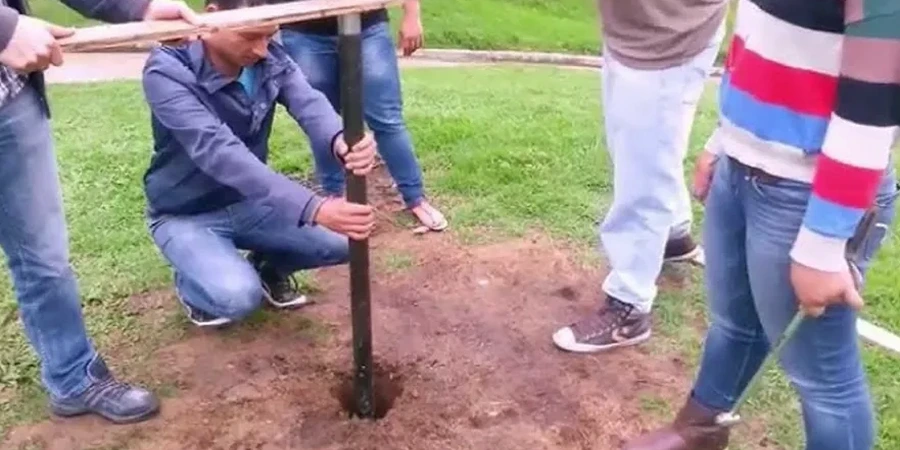
Illustrative image of Field vane shear test (VST) in Austin
The field vane shear test (VST) delivers undisturbed undrained shear strength in soft clays, with sensitivity data that no other in-situ test provides.
Our service areas

Process overview

Austin's geology includes the Taylor Group clay, which can have undrained shear strengths as low as 15 kPa near the surface and increase with depth. The field vane shear test (VST) captures that profile in situ without sample disturbance. The procedure follows ASTM D2573-19. We advance a borehole to the test depth, then push the vane 5 diameters below the bottom of the hole. A calibrated torque head rotates the vane at 0.1 deg/s until failure. After the initial test, we rotate the vane rapidly for 10 cycles to remold the soil and take a second reading. That gives the sensitivity ratio, which helps evaluate potential strength loss during construction. The test is fast: each reading takes about 2 minutes. We typically run VST at 1.5 m intervals in the clay zone. The equipment is portable, so access is rarely a problem even on tight urban lots in downtown Austin.
Technical reference — Austin

Local context

The Taylor clay in Austin can have high plasticity (PI > 60) and low peak shear strength. A foundation built on this clay without a field vane shear test (VST) may suffer bearing failure or excessive differential settlement. The risk is amplified in Austin's wet-dry cycles, where clay shrinks and swells. We have seen a two-story house near Slaughter Lane crack within a year because the designer assumed a higher undrained shear strength than the clay actually provided. The VST removes that guesswork. It also detects weak lenses or soft zones that standard sampling misses. For slope stability work in South Austin, the VST data feed directly into limit equilibrium analysis.

Need a geotechnical assessment?

Reply within 24h.

Email: contact@geotechnicalengineering1.com

Relevant standards


ASTM D2573-19 — Standard Test Method for Field Vane Shear Test in Saturated Fine-Grained Soils, ASTM D2488 — Standard Practice for Description and Identification of Soils (Visual-Manual Procedure), IBC 2021 Chapter 18 — Soils and Foundations

Technical data

ParameterTypical value
Vane dimensions75 mm height, 38 mm diameter (standard)
Torque capacity0.5 to 200 N·m
Test depth range1 m to 30 m
Shear rate0.05–0.2 deg/s (controlled)
Measured parametersPeak su, remolded su, sensitivity
Output resolution0.1 kPa

FAQ


What is the difference between a field vane shear test and a lab vane test?

The field vane shear test (VST) is performed in situ, so the soil is tested at its natural stress state and moisture content. A lab vane test uses a remolded or undisturbed sample taken to the laboratory, which can suffer from stress relief and sample disturbance. The VST typically yields more reliable results for soft clays because it avoids these artifacts.

How much does a field vane shear test cost in Austin?

A standard VST profile in Austin typically ranges from US$650 to US$1,330, depending on the number of test depths, site access conditions, and whether sampling is included. The price reflects the specialized equipment and the time required to advance a borehole and perform the vane tests at multiple depths.

Can the VST be used in stiff clays or sandy soils?

No. The field vane shear test is designed for soft to medium stiff clays with undrained shear strength below 200 kPa. In stiff clays or sandy soils, the vane may not penetrate without pre-drilling, and the torque required exceeds the tool capacity. For those soils, we recommend a [triaxial compression test](/) or a CPT instead.

What is the sensitivity ratio from a VST, and why does it matter?

Sensitivity is the ratio of peak undrained shear strength to remolded strength. A ratio above 8 indicates a sensitive clay that can lose most of its strength if disturbed. In Austin, some Taylor Group clays have sensitivity values between 4 and 10. Knowing this helps engineers design excavation slopes and select construction methods that avoid triggering a strength loss.

Location and service area

We serve projects across Austin.

Location and service area